- Your Product Type
- Your Study Type
- Aquatic Ecotoxicology
- Aquatic Invertebrates
- OECD 202: Daphnia sp., Acute Immobilisation Test
- OECD 211: Daphnia magna Reproduction Test
- OECD 235: Chironomus sp., Acute Immobilisation Test
- OECD 218/219: Sediment-Water Chironomid Toxicity Test Using Spiked Sediment/Spiked Water
- OECD 233: Sediment-Water Chironomid Life-Cycle Toxicity Test Using Spiked Water or Spiked Sediment
- OECD 225: Sediment-water Lumbriculus Toxicity Test Using Spiked Sediment
- OECD 242: Potamopyrgus antipodarum Reproduction Test
- OECD 243: Lymnaea stagnalis Reproduction Test
- Fish and other vertebrates
- OECD 203: Fish, Acute Toxicity Test
- OECD 215: Fish Juvenile Growth Study
- OECD 212: Fish, Short-term Toxicity Test on Embryo and Sac-fry Stages
- OECD 231: The Amphibian Metamorphosis Assay
- OECD 236: Fish Embryo Acute Toxicity Test
- OECD 210: Fish, Early-life Stage Toxicity Test
- OECD 229 Fish Short Term Reproduction Assay and OECD 230 21-day Fish Assay
- OECD 240 Medaka Extended One Generation Reproduction Test (MEOGRT)
- OECD 248: Xenopus Eleutheroembryonic Thyroid Assay
- OPPTS 850.1500: Fish Life Cycle Toxicity Test
- OÈCD 234 Fish sexual development test
- Aquatic plants
- Analytical Dose Verification
- Aquatic Invertebrates
- Chemistry
- Biodegradation Studies
- Analytical Chemistry Studies and Residues
- Physical-Chemical Properties Studies
- Storage Stability Studies
- OPPTS 830.6302, OPPTS 830.6303,and OPPTS 830.6304: Physical State, Colour and Odor at 20 °C and at 101.3 kPa
- EU A.1: Melting temperature/range
- EU A.2: Boiling temperature
- EU A.3: Relative density (liquids and solids)
- EU A.4: Vapour pressure
- EU A.5: Surface tension
- EU A.9: Flashpoint
- EU A.10: Flammability (solids)
- EU A.12: Flammability (contact with water)
- EU A.13: Pyrophoric properties of solids and liquids
- EU A.16: Relative self-ignition temperature for solids
- EU A.17: Oxidising properties
- OECD 114: Viscosity of Liquids
- Environmental Fate
- Transformation in Soil
- Transformation in Water
- Transformation in Manure
- Adsorption on Soil and Sewage Sludge
- Bioaccumulation and Bioconcentration
- Terrestrial Ecotoxicology
- Non-target Arthropods
- Non-target arthropod testing with the parasitic wasp (Aphidius rhopalosiphi)
- Non-target arthropod testing with the lacewing (Chrysoperla carnea)
- Non-target arthropod testing with the ladybird beetle (Coccinella septempunctata)
- Non-target arthropod testing with the predatory bug (Orius laevigatus)
- Non-target arthropod testing with the predatory mite (Typhlodromus pyri)
- Non-target arthropod testing with the rove beetle (Aleochara bilineata)
- Non-target arthropod testing with the carabid beetle (Poecilus cupreus)
- Non-target arthropod testing with the wolf spider (Pardosa spec.)
- Soil Organisms
- Honey Bees and other Pollinators
- OECD 213/214: Honey bees, Acute Oral and Acute Contact Toxicity Test
- OECD 245: Honey Bee (Apis Mellifera L.), Chronic Oral Toxicity Test (10-Day Feeding)
- OECD 237: Honey Bee Larval Toxicity Test, Single Exposure
- OECD 239: Honey Bee Larval Toxicity Test
- EPPO 170: Honey Bee Field Study – do plant protection products effect honey bee colonies?
- Oomen et al. 1992: Honey Bee Brood Feeding Study
- OECD 75: Honey Bee Brood Test under Semi-field Conditions in Tunnels
- OECD 246/247 Acute Oral and Contact Toxicity to the Bumblebee, Bombus terrestris L.
- Solitary Bee Acute Contact Toxicity Study in the Laboratory (Osmia sp.) Solitary Bee Acute Oral Toxicity Study in the Laboratory (Osmia sp.) (protocols for ringtests with solitary bees recommended by the non-Apis working group)
- SANTE/11956/2016 rev.9 Residue trials for MRL setting in honey
- Non-target plants
- OECD 208: Terrestrial Plant Test - Seedling Emergence and Seedling Growth Test
- OECD 227: Terrestrial Plant Test - Vegetative Vigour Test
- OCSPP 850.4100: Seedling Emergence and Seedling Growth
- OCSPP 850.4150: Vegetative Vigor
- EPPO PP 1/207(2): Efficacy evaluation of plant protection products, Effects on succeeding crops
- Field Studies
- Non-target Arthropods
- Ecological Modelling
- Quality Assurance
- Testing of Potential Endocrine Disruptors
- Aquatic Ecotoxicology
- News
- Company
- Career
- Contact

Omnibus X – A Simpler Regulatory Pathway for Biocontrol in the European Union?
30th September 2026
Blog by Jesica Fabro, Regulatory Affairs Manager Biocontrol Solutions, and Gianpiero Gueli Alletti, Lead Regulatory Affairs Manager Plant Protection Products at Vali Consulting
Why does simplification matter?
Biological plant protection products play an essential role in supporting sustainable agriculture. They help reduce reliance on conventional chemical pesticides, strengthen integrated pest management, and contribute to the European Union’s environmental and climate objectives. As more conventional active substances leave the market, growers need access to effective and sustainable alternatives.
Despite the efforts made in the past years to tailor the assessment framework to fit innovative active substances, biocontrol agents are still assessed through processes originally designed for conventional chemical active substances, leading to longer evaluation timelines and adding disproportionate levels of complexity. With this, we are at peril that developers and manufacturers of innovative biocontrol solutions prefer to shift their focus to other areas of the world, boasting smaller investments and shorter time-to-market.
Recognising these challenges, the European Commission has introduced the Omnibus X package as part of its broader agenda to simplify EU legislation and improve competitiveness. The proposal seeks to reduce unnecessary administrative burden while maintaining the high standards of environmental and human health protection that define the European regulatory system. For companies developing biological plant protection products, understanding these proposed changes is becoming increasingly important for strategic regulatory planning.
Where could simplification make a difference?
Although the legislative discussions are still ongoing, several areas have been identified where meaningful simplification could improve the approval process for biological plant protection products.
More proportionate data requirements
One of the main objectives is to ensure that data requirements better reflect the specific characteristics of biological products. Rather than applying assessment approaches designed for conventional chemical substances, the proposal encourages regulatory requirements that are scientifically appropriate for biological active substances.
Faster regulatory procedures
The package also aims to shorten approval timelines by reducing unnecessary administrative steps and improving procedural efficiency. Faster evaluations would allow innovative products to reach growers sooner without compromising the scientific quality of regulatory assessments.
Better alignment across Member States
Differences in the interpretation and implementation of regulatory requirements can create uncertainty for applicants. Greater harmonisation between Member States could improve consistency throughout the approval process and provide developers with a more predictable regulatory pathway.
Supporting innovation while maintaining protection
The overall objective is not to reduce scientific scrutiny, but to ensure that regulatory resources focus on the questions that matter most for environmental and human health. A more proportionate system would support innovation while preserving the robust risk assessments that underpin confidence in EU regulation.
Which challenges are we still facing?
While the need for simpler legislation and shorter regulatory processes, particularly in the biocontrol sector, is largely acknowledged, the proposed reforms have also generated important discussions among regulators and stakeholders.
For example, some Member States have raised concerns regarding the extent of the proposed changes and should not weaken the scientific rigour of environmental and human health assessments. Particularly, the proposed changes to the maximum residues of active substances have prompted debate about maintaining the high level of consumer protection in the EU.
Furthermore, discussions with industry representatives are ongoing regarding a much-anticipated definition of the term “biocontrol”, which is not yet covered by any legislative text in force. This is particularly significant because several simplification measures are intended specifically for biocontrol products.
Specifically, after the latest discussions it is debated that the scope of biocontrol may be linked to the existing “low risk” concept. Ironically, due in part to the administrative delays in the renewal of active substances and the lack of agreement among Member States, only a small proportion of the approved active substances fall within this category despite complying with the outlined data requirements for low risk. As a result, many biocontrol active substances with favourable safety profiles, but without current classifications as such, suffer from being omitted from the scope of the simplification measures.
What is the current status?
Since the European Commission presented the Omnibus X package as part of its wider simplification agenda, the legislative process has progressed steadily. During the first half of 2026, the Council, under the Cyprus Presidency, treated the package as a priority. Important milestones have already been achieved, including the adoption of targeted amendments to the Biocidal Products Regulation and agreement on the Council's position for the broader food and feed safety proposals.
Nevertheless, discussions on the remaining legislative proposals affecting plant protection products and other sector-specific legislation are still ongoing. The next phase will involve negotiations between the Council under the Irish Presidency, the European Parliament and the European Commission before the final legislative texts can be adopted. In this context, the Irish Presidency has confirmed that advancing the simplification packages will remain a key objective.
For the biocontrol sector, this means that legislative discussions are likely to accelerate over the coming months. Although the final outcome remains subject to negotiation, companies developing biological products should continue to monitor these developments closely and consider how potential changes may influence future regulatory strategies.
Looking ahead
Omnibus X represents an important opportunity to modernise the regulatory framework for biological plant protection products in the European Union. If implemented effectively, the proposal could create a more proportionate approval process that supports innovation while maintaining Europe’s high standards for environmental and human health protection.
Reducing unnecessary administrative complexity would allow both applicants and regulators to focus their efforts where they add the greatest value: generating scientifically robust data, preparing high-quality regulatory dossiers and engaging with competent authorities at an early stage of product development.
Regardless of the final legislative outcome, scientific excellence will remain the foundation of successful regulatory submissions. By combining robust environmental studies with a well-planned regulatory strategy, companies can navigate evolving requirements more effectively while contributing to safer, more sustainable agriculture.
At Vali Consulting and Ibacon GmbH, we believe that responsible science and clear regulatory pathways go hand in hand. Together, they enable innovation that protects crops, safeguards ecosystems and supports a more sustainable future for agriculture.
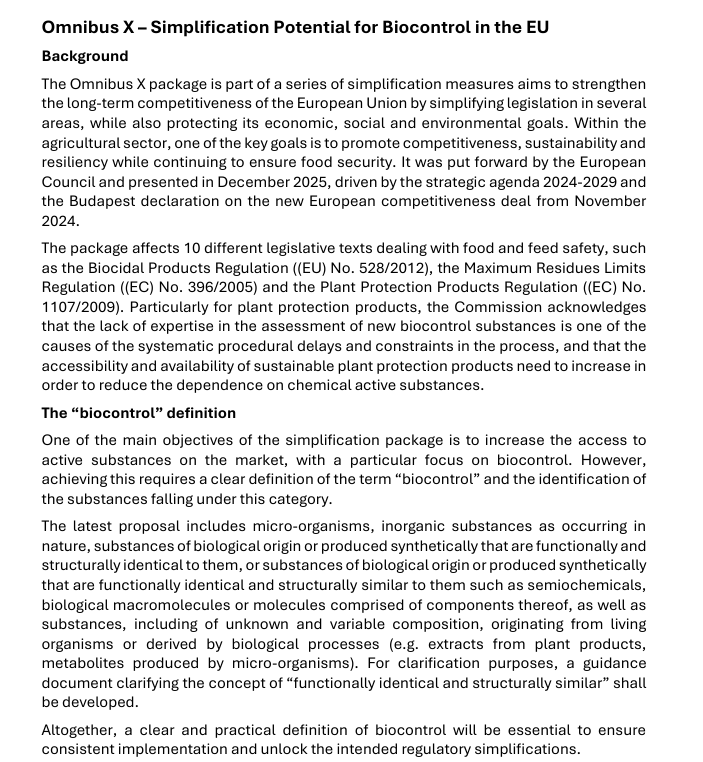
Download the document to explore the impact of Omnibus X on biocontrol regulation.