- Your Product Type
- Your Study Type
- Aquatic Ecotoxicology
- Aquatic Invertebrates
- OECD 202: Daphnia sp., Acute Immobilisation Test
- OECD 211: Daphnia magna Reproduction Test
- OECD 235: Chironomus sp., Acute Immobilisation Test
- OECD 218/219: Sediment-Water Chironomid Toxicity Test Using Spiked Sediment/Spiked Water
- OECD 233: Sediment-Water Chironomid Life-Cycle Toxicity Test Using Spiked Water or Spiked Sediment
- OECD 225: Sediment-water Lumbriculus Toxicity Test Using Spiked Sediment
- OECD 242: Potamopyrgus antipodarum Reproduction Test
- OECD 243: Lymnaea stagnalis Reproduction Test
- Fish and other vertebrates
- OECD 203: Fish, Acute Toxicity Test
- OECD 215: Fish Juvenile Growth Study
- OECD 212: Fish, Short-term Toxicity Test on Embryo and Sac-fry Stages
- OECD 231: The Amphibian Metamorphosis Assay
- OECD 236: Fish Embryo Acute Toxicity Test
- OECD 210: Fish, Early-life Stage Toxicity Test
- OECD 229 Fish Short Term Reproduction Assay and OECD 230 21-day Fish Assay
- OECD 240 Medaka Extended One Generation Reproduction Test (MEOGRT)
- OECD 248: Xenopus Eleutheroembryonic Thyroid Assay
- OPPTS 850.1500: Fish Life Cycle Toxicity Test
- OÈCD 234 Fish sexual development test
- Aquatic plants
- Analytical Dose Verification
- Aquatic Invertebrates
- Chemistry
- Biodegradation Studies
- Analytical Chemistry Studies and Residues
- Physical-Chemical Properties Studies
- Storage Stability Studies
- OPPTS 830.6302, OPPTS 830.6303,and OPPTS 830.6304: Physical State, Colour and Odor at 20 °C and at 101.3 kPa
- EU A.1: Melting temperature/range
- EU A.2: Boiling temperature
- EU A.3: Relative density (liquids and solids)
- EU A.4: Vapour pressure
- EU A.5: Surface tension
- EU A.9: Flashpoint
- EU A.10: Flammability (solids)
- EU A.12: Flammability (contact with water)
- EU A.13: Pyrophoric properties of solids and liquids
- EU A.16: Relative self-ignition temperature for solids
- EU A.17: Oxidising properties
- OECD 114: Viscosity of Liquids
- Environmental Fate
- Transformation in Soil
- Transformation in Water
- Transformation in Manure
- Adsorption on Soil and Sewage Sludge
- Bioaccumulation and Bioconcentration
- Terrestrial Ecotoxicology
- Non-target Arthropods
- Non-target arthropod testing with the parasitic wasp (Aphidius rhopalosiphi)
- Non-target arthropod testing with the lacewing (Chrysoperla carnea)
- Non-target arthropod testing with the ladybird beetle (Coccinella septempunctata)
- Non-target arthropod testing with the predatory bug (Orius laevigatus)
- Non-target arthropod testing with the predatory mite (Typhlodromus pyri)
- Non-target arthropod testing with the rove beetle (Aleochara bilineata)
- Non-target arthropod testing with the carabid beetle (Poecilus cupreus)
- Non-target arthropod testing with the wolf spider (Pardosa spec.)
- Soil Organisms
- Honey Bees and other Pollinators
- OECD 213/214: Honey bees, Acute Oral and Acute Contact Toxicity Test
- OECD 245: Honey Bee (Apis Mellifera L.), Chronic Oral Toxicity Test (10-Day Feeding)
- OECD 237: Honey Bee Larval Toxicity Test, Single Exposure
- OECD 239: Honey Bee Larval Toxicity Test
- EPPO 170: Honey Bee Field Study – do plant protection products effect honey bee colonies?
- Oomen et al. 1992: Honey Bee Brood Feeding Study
- OECD 75: Honey Bee Brood Test under Semi-field Conditions in Tunnels
- OECD 246/247 Acute Oral and Contact Toxicity to the Bumblebee, Bombus terrestris L.
- Solitary Bee Acute Contact Toxicity Study in the Laboratory (Osmia sp.) Solitary Bee Acute Oral Toxicity Study in the Laboratory (Osmia sp.) (protocols for ringtests with solitary bees recommended by the non-Apis working group)
- SANTE/11956/2016 rev.9 Residue trials for MRL setting in honey
- Non-target plants
- OECD 208: Terrestrial Plant Test - Seedling Emergence and Seedling Growth Test
- OECD 227: Terrestrial Plant Test - Vegetative Vigour Test
- OCSPP 850.4100: Seedling Emergence and Seedling Growth
- OCSPP 850.4150: Vegetative Vigor
- EPPO PP 1/207(2): Efficacy evaluation of plant protection products, Effects on succeeding crops
- Field Studies
- Non-target Arthropods
- Ecological Modelling
- Quality Assurance
- Testing of Potential Endocrine Disruptors
- Aquatic Ecotoxicology
- News
- Company
- Career
- Contact

Water Treatment Transformation Products: What the New EU Guidance Means
27th April 2026
Blog by Kevin O’Brien, Senior Regulatory Affairs Manager Environmental Fate at Vali Consulting
Purpose – Why this topic matters
From April 2026, EU regulations will require the assessment of how substances behave during drinking water treatment. This represents an important evolution in regulatory science, as it goes beyond evaluating the original substance and its environmental metabolites alone.
During drinking water treatment, substances may be transformed into new compounds. These transformation products can differ significantly in their chemical and toxicological properties, with potential implications for human health and environmental safety.
Understanding and addressing these transformation products is now essential for compliance, robust risk assessment, and the protection of drinking water quality
Background – The scientific and regulatory context
Current regulatory frameworks already require that substances do not pose a risk to human or animal health via drinking water exposure.
Until now, assessments have primarily focused on environmental fate processes occurring before water abstraction.
The new guidance closes an important gap by recognising that drinking water treatment processes—such as chlorination or ozonation—may not fully remove substances but instead transform them into new chemical entities.
This updated framework will become mandatory for plant protection products and biocides submitted from April 2026 onward.
Scientific process – How we address the challenge
The guidance follows a structured, step-by-step approach to determine whether further assessment is required.
Step 1: Exposure assessment
The first step is to evaluate whether residues can reach drinking water sources.
A key regulatory trigger is 0.1 µg/L. If predicted concentrations remain below this threshold, no further assessment is required.
If the threshold is exceeded, the assessment continues and surface water exposure estimates are refined using dilution factors.
Step 2: Transformation during treatment
The next step evaluates what happens during drinking water treatment.
Relevant processes include chlorination, ozonation, UV disinfection, and filtration.
The assessment begins with available literature data and predictive models such as QSAR to evaluate substance stability. If stability is demonstrated, experimental testing may not be required.
If uncertainty remains, experimental studies are conducted.
Testing typically starts at elevated concentrations to identify potential transformation products and is then repeated at environmentally relevant levels.
Only transformation products exceeding 0.075 µg/L at relevant conditions are taken forward for further assessment.
Step 3: Toxicity assessment
If transformation products are identified, their toxicological relevance must be evaluated.
- Tier 1: focuses on genotoxicity. In the absence of data, a conservative approach is applied.
- Tier 2: assesses general toxicity, often using the Threshold of Toxicological Concern (TTC) approach.
- Tier 3: includes more detailed studies where uncertainty remains.
Implications for Industry
This new guidance increases both scientific and regulatory complexity.
Early exposure modelling becomes critical, as it determines whether further assessment of transformation products is triggered.
Testing requirements are also becoming more demanding. Simulating drinking water treatment processes and identifying unknown compounds requires advanced analytical methodologies and robust experimental design.
In some cases, entirely new substances or transformation products may need to be assessed. This can involve additional analytical work as well as toxicological studies.
Timelines and regulatory outcomes may be impacted if risks are identified during the assessment process.
Early planning and integrated strategies therefore play a key role in reducing uncertainty and avoiding delays.
Conclusion
The new guidance reflects a more complete and realistic view of environmental risk assessment.
It ensures that drinking water safety is evaluated across the full lifecycle of a substance, including transformation processes during water treatment.
By addressing transformation products early in the development process, it is possible to support regulatory compliance while strengthening the scientific basis for protecting human health.
At the same time, this approach reinforces responsible innovation and long-term environmental protection.
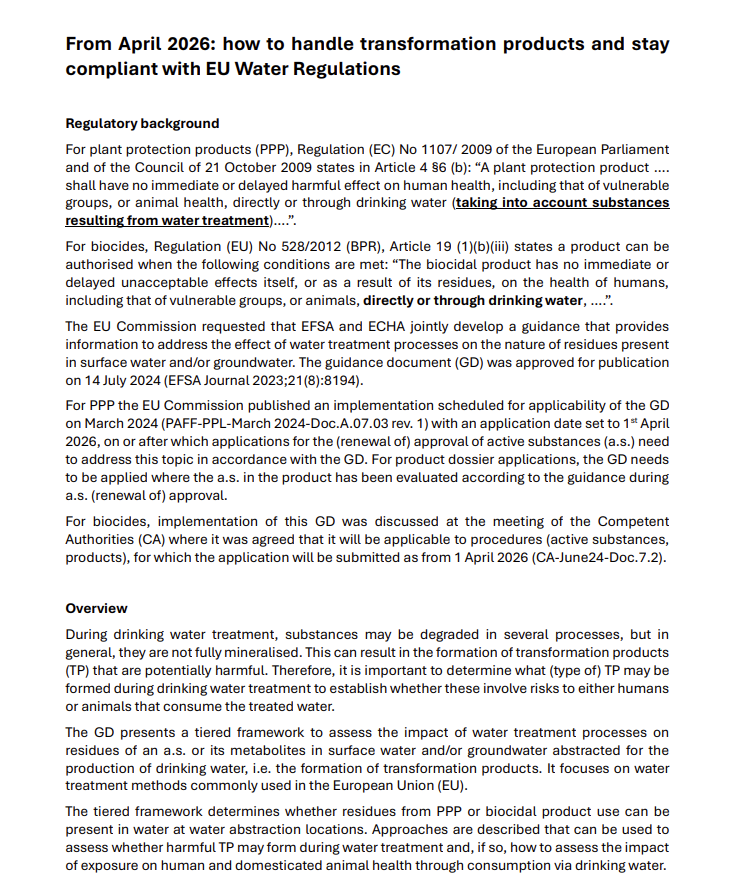
Download the whitepaper to learn more about the 2026 requirements.